
 Donate
Kevin Riford
By any measure, Jeffrey Epstein received one of the most controversial plea agreements in modern American history. His 2008 deal in Palm Beach has been described by victims, legal scholars, and prosecutors themselves as extraordinarily lenient.
Among the prosecutors whose names appear in the public record is Assistant State Attorney Barbara Burns, who participated in later proceedings involving Epstein’s supervision. One email released years later has become a focal point of renewed scrutiny.
In that email, Burns described Epstein as being “fortunate to get the deal of the century.”

The phrase is often quoted, but the full email provides important context.

E-mail source: https://jmail.world/thread/EFTA02728854?view=inbox
Burns wrote:
“…his client is a registered sex offender that was fortunate to get the deal of the century, fortunate enough…to be granted work release while serving his jail sentence…and certainly fortunate to plea at a time when it was not required…that he be placed on sex offender probation with all of the restrictive conditions that the vast majority of individuals in his similar situation would have been subjected to.”
Burns lists privilege after privilege—work release, lighter probation, and a plea agreement unavailable to most comparable offenders.
But that acknowledgment raises its own set of difficult questions.
If Prosecutor Barbara Burns Knew, What Did She Do?
Burns’ email demonstrates that she recognized Epstein had received exceptional treatment.
If Epstein truly had received “the deal of the century,” as Burns described it, several questions naturally follow:
1.) Why did prosecutors continue defending aspects of the existing arrangement rather than aggressively seeking every available legal avenue to tighten Epstein’s supervision?
2.) Did Burns recommend stronger restrictions once she recognized how favorable Epstein’s resolution had been?
3.) Did anyone within the Palm Beach State Attorney’s Office push to revisit or challenge Epstein’s extraordinary privileges where the law allowed?
4.) Were there internal disagreements that have never become public?
5.) Was Jeffrey Epstein a U.S. Intelligence Asset?
Still, acknowledging extraordinary leniency invites scrutiny of what came next.
An Earlier Case Few Remember
More than a decade before the Epstein controversy became international news, Burns handled another serious criminal prosecution that ended under troubling circumstances.
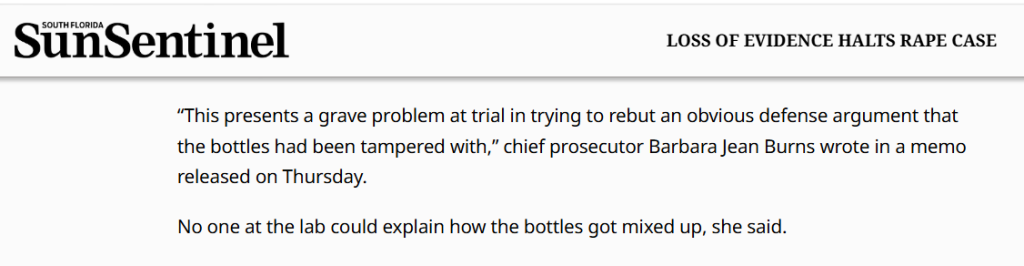
In 1997, Burns prosecuted a rape case that ultimately collapsed after critical evidence disappeared before trial. source: https://www.sun-sentinel.com/1997/02/28/loss-of-evidence-halts-rape-case/
According to contemporaneous reporting by the Sun-Sentinel, the judge dismissed the charges after determining that the missing evidence prevented the defendant from receiving a fair trial.
The circumstances remain troubling.
How does critical evidence in a violent felony prosecution simply vanish?
Who was responsible for maintaining custody?
Was there an internal investigation?
Were any procedures changed afterward?
Was anyone disciplined?
A Pattern of Difficult Questions
The Epstein email detailing Epstein’s “deal of the century”
The 1997 rape case documents the collapse of a prosecution after evidence was “lost”
Yet together, the two cases raise broader questions about accountability within the Palm Beach State Attorney’s Office.
In one case, Barbara Burns acknowledged that one of America’s most notorious sex offenders had received extraordinary legal advantages.
In another, a Barbara Burns rape prosecution ended because essential evidence simply vanished. Barbara did not have a clue how this evidence disappeared.
Neither outcome inspires confidence in the administration of justice.
The Questions That Remain
More than two decades later, many questions remain unanswered.
- When Burns concluded Epstein had received “the deal of the century,” what actions did she personally take to oppose further preferential treatment?
- Did she ever recommend stronger enforcement of Epstein’s probation or work-release conditions?
- What internal discussions occurred within the State Attorney’s Office regarding Epstein’s continued requests for additional concessions?
- In the 1997 rape prosecution, how exactly did the evidence disappear?
- Who had custody of that evidence?
- Was the disappearance ever fully investigated?
- Were reforms implemented after the case collapsed?
These are not accusations.
They are questions arising from the public record.
The Epstein case remains one of the greatest failures of modern criminal justice. Burns’ email reflects awareness that Epstein had already received exceptional treatment. The earlier collapse of a rape prosecution because of missing evidence illustrates another episode where the justice system failed to deliver a resolution on the merits.
Whether viewed separately or together, both cases underscore the importance of public scrutiny whenever confidence in the legal system is tested.